 So it all started with a bit of a joke – I was chatting to moderator-extraordinaire @sourcePOV (Chris Jones’ alias on Twitter to the rest of you) at the end of a particularly well attended #smchat session to brainstorm some ideas for future chat topics (click here to find out more about #smchat). “Hey”, I said with tongue firmly in cheek, “we’ve been talking about social media and web 2.0 for some time now… aren’t we due another point release soon?”…. Chris, with what I’m now realizing is a rather impressive ability to spot an opportunity, quickly managed to convert my offhand quip into a somewhat tenuous agreement to take over from him as moderator for next week’s #smchat gathering, with rather daunting task of leading the 50+ participants through “Qu.20” – figuring out what Web 3.0 is, might be, or would be, if it is anything at all – and then trying to understand the impact on business and beyond.
I found myself wondering if this was how Justin Timberlake found himself not only guest hosting Saturday Night Life, but then also in tights and high heels for a parody of Beyonce’s “Single Ladies”… At some point he must’ve found himself thinking “How the heck….?”… I guess in retrospect I should thank my lucky stars that I get to keep my trousers on to host #smchat…
Taking a closer look at the topic though, led me to some very interesting search into a future that really isn’t that far away – (many experts seem to suggest that Web 3.0 will be a real entity as close as 2010) – but one that is still unclear and the center of some debate as to what it really is, will be, and what it will mean.
Let’s take a quick look down the “point release” history of the Web:
Web 0.0 was the first interactions between computers – the beginning of a networked world as it evolved. Crude, and of limited use (by today’s standards), but a huge step change on what was possible with individual computers.
Web 1.0 took the next step and evolved protocols and common language to begin making sense and use the growing “web” of interconnected computers in both the private and public sectors. Data was primarily pushed at you with little intelligence about how and why; and content creation and distribution was the sole domain of the website owner. However it spawned a wealth of business models that managed to take advantage of a new, non-physical channel by which to sell and promote goods and services.
Web 2.0 introduced the concept of a two way web – with users not only reading information, but also writing, contributing, and creating content.
It’s given birth to the business models of co-creation, open innovation networks, crowd sourcing, wisdom of crowd approaches, and enough buzzwords to run a truly interesting and diverse game of “buzzword bingo” at the office. It’s also introduced the concept of data and application mobility and a whole new level of interconnectedness with open standards beginning to evolve and standardize how machines, even from competing brands, talk to each other.

It’s a social, collaborative, and altogether more responsive and interactive web that is no longer just a tool, but a part of us and how we interact with the wider world around us.
So bearing in mind that marketing guys can be as unoriginal as a mullet at a Lynard Skynard concert when it comes to naming new concepts – we know a Web 3.0 is on its way – but what, if anything, will it be?
Here’s a nice little short movie from Dutch think tank EPN which does a nice job of introducing the Web 3.0 concept in relation to what’s gone before:
I don’t know about you, but I’m quite excited to see what the #smchat participants will come up with (Bet you’re jealous now Chris! :p ) – and to better prepare you all to discuss the topic, here’s some background reading on what some people think the Web 3.0, along with a list of some of the questions we’ll try to tackle on Wednesday:
Q20a) What is Web 3.0?
So what will Web3.0 bring us? Will it simply be a natural extension of Web 2.0? Will it just be a marketing gimmick devised by bored marketers looking to revitalize and differentiate a market where almost everything has been branded with a “2.0” by now? Or something totally different?
Alan Cho wrote a pretty nice article on the subject last year that does a good job of amalgamating some of the current arguments out there into a comprehensive prediction of what Web 3.0 might be characterized by, including:
– The advent of a truly intelligent web – the development of contextual searches will finally make sense of the plethora of online information and will eventually spawn intelligent web applications able fully understand what you’re really looking for in natural English.
– New levels of Openness and Increased levels of Interoperability – with users being able to skip from device to device and application to application using one single ID to seamlessly manage their online world – with the web being seen as essentially one really huge database. A worldwide cloud without edges if you will.
– A 3 dimensional web – not only in terms of Second Life type Avatars, but also crossing into the real world and integrating into everything you own. The web becomes an additional layer of information overlaying all aspects of your life, enriching the information flow your eyes process.
Q20b) What will be the hallmarks of a Web 3.0 world and how will it revolutionize the world?
Here’s a more academic view of Web 3.0 by a UCal professor:
Q20c) When will Web 3.0 be officially here?
The phrase “Web 2.0” was apparently coined in 2003 by Dale Dougherty, a vice-president at O’Reilly Media, and the phrase became popular in 2004. Some experts are saying that if the next fundamental change happened in roughly the same time span, Web 3.0 will be knocking on our doors sometime around 2015. Others seem to think that it could be upon us as soon as 2010! Time for all you Nostradamus wannabe’s to get your diving rods out on this one!
Q20d) What are the barriers to W3.0 ?
What’s stopping us from getting there? What are the major barriers that companies and consumers need to overcome? And what are the enabling features?
And finally, what I think is the most important question:
Q20e) What does Web 3.0 mean for businesses?
In this amusing interchange with a journalist, Eric Schmidt of Google gives a brief insight into what he thinks are some of the implications of web 3.0 including an interesting prediction that “Applications will be distributed in a viral manner” in the future.
Want more? Some further suggested reading:
http://www.labnol.org/internet/web-3-concepts-explained/8908/ – has a bunch of presentations from various peoples on what web3.0 might end up being.
http://computer.howstuffworks.com/web-30.htm – a good comprehensive look at all elements of Web 3.0
http://www.pcmag.com/article2/0,2817,2102865,00.asp – A nearby vision of how web 3.0 is evolving (hopefully not with all the annoying ads their site seems to be overridden with though…)
This #SMCHAT will be held on Wednesday, September 23rd, 2009 at 1PM EST on Twitter. If you’ve never participated in a Twitter chat before – here’s a useful post by Jeff Hurt that can help you get started!
And if you want to suggest some more questions for us to tackle (time permitting) feel free to post your suggestions in the comments below or via twitter on @bpluskowski – See you on Wednesday!

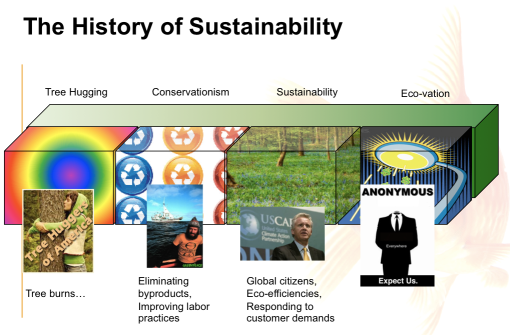
 Whilst there was more than a touch of cynicism, and a fair dose lot of tongue-in-cheek in that history – there was also, in my mind, a lot of truth in there too, and it served well to ridicule managers still stuck in yesteryear with regards to their attitudes to corporate green initiatives.

 Nike defines waste as “anything that doesn’t end up in the consumer’s closet” – the annual value of the waste they throw away amounts to an incredible $844,000,000 per annum – so finding even a manner to reduce waste by 1% can lead to significant financial gains
 UPS made headlines a few years ago when they rerouted their delivery routes to eliminate left hand turns – significantly reducing the amount of time their trucks spent idling waiting for a red light (For international readers, in the US, drivers in many states are allowed to make right hand turns on a red light). UPS also introduced a system whereby in certain cities with tight parking or narrow streets (like New York City for example) the driver will park his truck once in a central location, and then delivers smaller packages to the local area by bicycle instead. Whilst these seem like very green initiatives, they also increase efficiency, and reduce fuel expense – a double whammy for UPS!
 I’m excited to see where the next generation of environmental agents takes the corporations of the future – for the next stage of environmental innovation is upon us – and that HAS to be good thing! Go forth and be green everyone!





 The Complete Innovator